No Image

USN-6031-1: Linux kernel (OEM) vulnerabilities

2023-04-20 KENNETH 0

USN-6031-1: Linux kernel (OEM) vulnerabilities It was discovered that the Traffic-Control Index (TCINDEX) implementation in the Linux kernel contained a use-after-free vulnerability. A local attacker could use this to cause a denial of service (system crash) or possibly execute arbitrary code. (CVE-2023-1281) It was discovered that the Integrity Measurement Architecture (IMA) implementation in the Linux kernel did not properly enforce policy in certain conditions. A privileged attacker could use this to bypass Kernel lockdown restrictions. (CVE-2022-21505) It was discovered that the infrared transceiver USB driver did not properly handle USB control messages. A local attacker with physical access could plug in a specially crafted USB device to cause a denial of service (memory exhaustion). (CVE-2022-3903) It was discovered that a race condition existed in the SMSC UFX USB driver implementation in the Linux kernel, leading to a use-after-free vulnerability. A [ more… ]

A Primer on QUIC Networking and Encryption in NGINX

2023-04-20 KENNETH 0

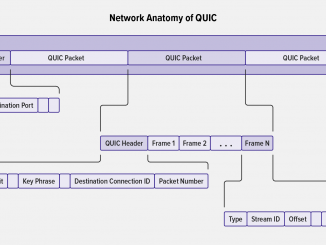
A Primer on QUIC Networking and Encryption in NGINX table.nginx-blog, table.nginx-blog th, table.nginx-blog td { border: 2px solid black; border-collapse: collapse; } table.nginx-blog { width: 100%; } table.nginx-blog th { background-color: #d3d3d3; align: left; padding-left: 5px; padding-right: 5px; padding-bottom: 2px; padding-top: 2px; line-height: 120%; } table.nginx-blog td { padding-left: 5px; padding-right: 5px; padding-bottom: 2px; padding-top: 5px; line-height: 120%; } table.nginx-blog td.center { text-align: center; padding-bottom: 2px; padding-top: 5px; line-height: 120%; } The first mention of QUIC and HTTP/3 on the NGINX blog was four years ago (!), and like you we’re now eagerly looking forward to the imminent merging of our QUIC implementation into the NGINX Open Source mainline branch. Given the long gestation, it’s understandable if you haven’t QUIC much thought. At this point, however, as a developer or site administrator you need to be aware of how QUIC [ more… ]

No Image

USN-6030-1: Linux kernel (Qualcomm Snapdragon) vulnerabilities

2023-04-19 KENNETH 0

USN-6030-1: Linux kernel (Qualcomm Snapdragon) vulnerabilities It was discovered that the Traffic-Control Index (TCINDEX) implementation in the Linux kernel contained a use-after-free vulnerability. A local attacker could use this to cause a denial of service (system crash) or possibly execute arbitrary code. (CVE-2023-1281) It was discovered that the System V IPC implementation in the Linux kernel did not properly handle large shared memory counts. A local attacker could use this to cause a denial of service (memory exhaustion). (CVE-2021-3669) It was discovered that a use-after-free vulnerability existed in the SGI GRU driver in the Linux kernel. A local attacker could possibly use this to cause a denial of service (system crash) or possibly execute arbitrary code. (CVE-2022-3424) Ziming Zhang discovered that the VMware Virtual GPU DRM driver in the Linux kernel contained an out-of-bounds write vulnerability. A local attacker could [ more… ]

No Image

USN-6029-1: Linux kernel vulnerabilities

2023-04-19 KENNETH 0

USN-6029-1: Linux kernel vulnerabilities It was discovered that the Traffic-Control Index (TCINDEX) implementation in the Linux kernel contained a use-after-free vulnerability. A local attacker could use this to cause a denial of service (system crash) or possibly execute arbitrary code. (CVE-2023-1281) It was discovered that the infrared transceiver USB driver did not properly handle USB control messages. A local attacker with physical access could plug in a specially crafted USB device to cause a denial of service (memory exhaustion). (CVE-2022-3903) It was discovered that the Human Interface Device (HID) support driver in the Linux kernel contained a type confusion vulnerability in some situations. A local attacker could use this to cause a denial of service (system crash). (CVE-2023-1073) It was discovered that a memory leak existed in the SCTP protocol implementation in the Linux kernel. A local attacker could use [ more… ]

No Image

USN-6028-1: libxml2 vulnerabilities

2023-04-19 KENNETH 0

USN-6028-1: libxml2 vulnerabilities It was discovered that lixml2 incorrectly handled certain XML files. An attacker could possibly use this issue to cause a crash or execute arbitrary code. (CVE-2023-28484) It was discovered that libxml2 incorrectly handled certain XML files. An attacker could possibly use this issue to cause a crash. (CVE-2023-29469) Source: USN-6028-1: libxml2 vulnerabilities