
No Image

USN-6001-1: Linux kernel (AWS) vulnerabilities

2023-04-06 KENNETH 0

USN-6001-1: Linux kernel (AWS) vulnerabilities Xuewei Feng, Chuanpu Fu, Qi Li, Kun Sun, and Ke Xu discovered that the TCP implementation in the Linux kernel did not properly handle IPID assignment. A remote attacker could use this to cause a denial of service (connection termination) or inject forged data. (CVE-2020-36516) Ke Sun, Alyssa Milburn, Henrique Kawakami, Emma Benoit, Igor Chervatyuk, Lisa Aichele, and Thais Moreira Hamasaki discovered that the Spectre Variant 2 mitigations for AMD processors on Linux were insufficient in some situations. A local attacker could possibly use this to expose sensitive information. (CVE-2021-26401) Jürgen Groß discovered that the Xen subsystem within the Linux kernel did not adequately limit the number of events driver domains (unprivileged PV backends) could send to other guest VMs. An attacker in a driver domain could use this to cause a denial of service [ more… ]
No Image

USN-6000-1: Linux kernel (BlueField) vulnerabilities

2023-04-06 KENNETH 0

USN-6000-1: Linux kernel (BlueField) vulnerabilities It was discovered that the Upper Level Protocol (ULP) subsystem in the Linux kernel did not properly handle sockets entering the LISTEN state in certain protocols, leading to a use-after-free vulnerability. A local attacker could use this to cause a denial of service (system crash) or possibly execute arbitrary code. (CVE-2023-0461) It was discovered that the NVMe driver in the Linux kernel did not properly handle reset events in some situations. A local attacker could use this to cause a denial of service (system crash). (CVE-2022-3169) It was discovered that a use-after-free vulnerability existed in the SGI GRU driver in the Linux kernel. A local attacker could possibly use this to cause a denial of service (system crash) or possibly execute arbitrary code. (CVE-2022-3424) Gwangun Jung discovered a race condition in the IPv4 implementation in [ more… ]

No Image

USN-5998-1: Apache Log4j vulnerabilities

2023-04-06 KENNETH 0

USN-5998-1: Apache Log4j vulnerabilities It was discovered that the SocketServer component of Apache Log4j 1.2 incorrectly handled deserialization. An attacker could possibly use this issue to execute arbitrary code. This issue only affected Ubuntu 16.04 ESM. (CVE-2019-17571) It was discovered that the JMSSink component of Apache Log4j 1.2 incorrectly handled deserialization. An attacker could possibly use this issue to execute arbitrary code. (CVE-2022-23302) It was discovered that Apache Log4j 1.2 incorrectly handled certain SQL statements. A remote attacker could possibly use this issue to perform an SQL injection attack and alter the database. This issue was only fixed in Ubuntu 18.04 LTS and Ubuntu 20.04 LTS. (CVE-2022-23305) It was discovered that the Chainsaw component of Apache Log4j 1.2 incorrectly handled deserialization. An attacker could possibly use this issue to execute arbitrary code. This issue was only fixed in Ubuntu 18.04 [ more… ]

No Image

Microsoft Edge Workspaces public preview is now available

2023-04-06 KENNETH 0

Microsoft Edge Workspaces public preview is now available Last fall, at Ignite, we announced the enterprise public preview of Microsoft Edge Workspaces. Since then, we’ve been hard at work to make it available more broadly and allow you to try Edge Workspaces in your home life.  Today, we are excited to announce that we’re opening Edge Workspaces for a limited public preview. We want to continue to build out this game-changing, collaborative feature, and we cannot do it without valuable feedback from Edge users. Today, we want to share what you can do with Edge Workspaces and how it can help you get more done, together. We’ll also share how you can join the public preview and be one of the first to try Edge Workspaces. Stay focused At Microsoft Edge, helping you get more done and multitask smarter is [ more… ]

Managing Kubernetes Cost and Performance with Kubecost and NGINX

2023-04-06 KENNETH 0

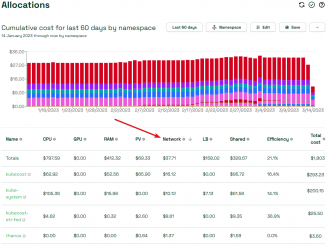
Managing Kubernetes Cost and Performance with Kubecost and NGINX Balancing cost and risk is top of mind for enterprises today. But without sufficient visibility, it is impossible to know if resources are being used effectively or consistently. Kubernetes enables complex deployments of containerized workloads, which are often transient and consume variable amounts of cluster resources. That makes cloud environments a great fit for Kubernetes, because they offer pricing models where you only pay for what you use, instead of having to overprovision in anticipation of peak loads. Of course, cloud vendors charge a premium for that convenience. What if you could unlock the dynamic load balancing of public cloud, without the cost? And what if you could use the same solution for your on‑premises and public cloud deployments? Now you can. Kubecost and NGINX are helping Kubernetes users reduce complexity [ more… ]