
No Image

Advance Notification Service for the December 2014 Security Bulletin Release

2014-12-05 KENNETH 0

Today, we provide advance notification for the release of seven Security Bulletins. Three of these updates are rated Critical and four are rated as Important in severity. These updates are for Microsoft Windows, Internet Explorer (IE), Office and Exchange. As per our monthly process, we’ve scheduled the Security Bulletin release for the second Tuesday of the month, December 9, 2014, at approximately 10 a.m. PDT. Until then, please review the ANS summary page for more information to help you prepare for Security Bulletin testing and deployment. Follow us on Twitter at @MSFTSecResponse Tracey Pretorius, Director Response Communications Source: ms-msrc
No Image

Security Bulletin MS14-068 released

2014-11-20 KENNETH 0

Today, we released an out-of-band security update to address a vulnerability in Kerberos which could allow Elevation of Privilege. This update is for all supported versions of Windows Server and includes a defense-in-depth update for all supported versions of Windows. We strongly encourage customers to apply this update as soon as possible by following the directions in Security Bulletin MS14-068. Tracey Pretorius, Director Response Communications Source: ms-msrc

No Image

Out-of-band release for Security Bulletin MS14-068

2014-11-18 KENNETH 0

On Tuesday, November 18, 2014, at approximately 10 a.m. PST, we will release an out-of-band security update to address a vulnerability in Windows. We strongly encourage customers to apply this update as soon as possible, following the directions in the security bulletin. More information about this bulletin can be found at Microsoft’s Bulletin Summary page. Tracey Pretorius, Director Response Communications Source: ms-msrc

No Image

November 2014 Updates

2014-11-12 KENNETH 0

Today, as part of Update Tuesday, we released 14 security updates – four rated Critical, nine rated Important, and two rated Moderate, to address 33 Common Vulnerabilities and Exposures (CVEs) in Microsoft Windows, Internet Explorer (IE), Office, .NET Framework, Internet Information Services (IIS), Remote Desktop Protocol (RDP), Active Directory Federation Services (ADFS), Input Method Editor (IME) (Japanese), and Kernel Mode Driver (KMD). We encourage you to apply all of these updates, but for those who need to prioritize deployment planning, we recommend focusing on the Critical updates first. For additional insight on deployment priority, review the Security Research and Defense blog “Assessing risk for the November 2014 security updates.” For more information about this month’s security updates, including the detailed view of the Exploit Index (XI) broken down by each CVE, visit the Microsoft Bulletin Summary webpage. If you are [ more… ]

L4 장비의 동작과 서비스 배포시 유의점

2014-05-30 KENNETH 0

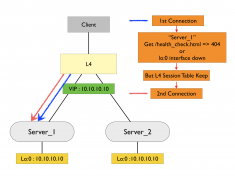
L4 장비의 동작과 서비스 배포시 유의점 개요 현재 카카오에서 대부분의 웹서버는 L3DSR (Direct Server Return)구성의 L7 HealthCheck 방식을 사용 중입니다. L7 HealthCheck 방식은 앞서 블로그에서 기술한적이 있는 것처럼 OSI 7Layer 중 Layer7 계층의 어플리케이션 응답을 체크하는 방식입니다. 카카오에서는 L4장비가 주기적으로 서버와 TCP 세션을 맺고 GET /health_check.html 의 Request로 응답코드를 확인 하는 방식입니다. 그러나 최근 여러개의 서비스에서 HTTP Keep-Alive 를 사용중이고 이에 따라 배포시 의도하지 않은 문제점이 발생할 수 있어 이에 대한 회피에 대해 기술하도록 하겠습니다. 현재 카카오 배포 방식 카카오에서 몇몇 서비스의 서버개발자 분들께서 웹서버 배포, 서비스에서 제외시 L4장비의 GET /health_check.html Request에 대해 404 응답코드를 내려주려고 health_check.html 파일을 리네임하거나 이동, 삭제 하는등의 방법을 사용중입니다. 쉽게 생각해서 L4 장비의 Request에 대해 404 응답코드를 내려줌으로써 VIP로 묶인 바인딩 서버리스트에서 제거 될것이라 생각하고 위와 같은 과정으로 서비스에서 제외 후 배포하는 경우가 많습니다. 현재 카카오 배포 방식의 문제점 위의 말씀드린 것처럼 health_check.html 파일에 대해서만 [ more… ]